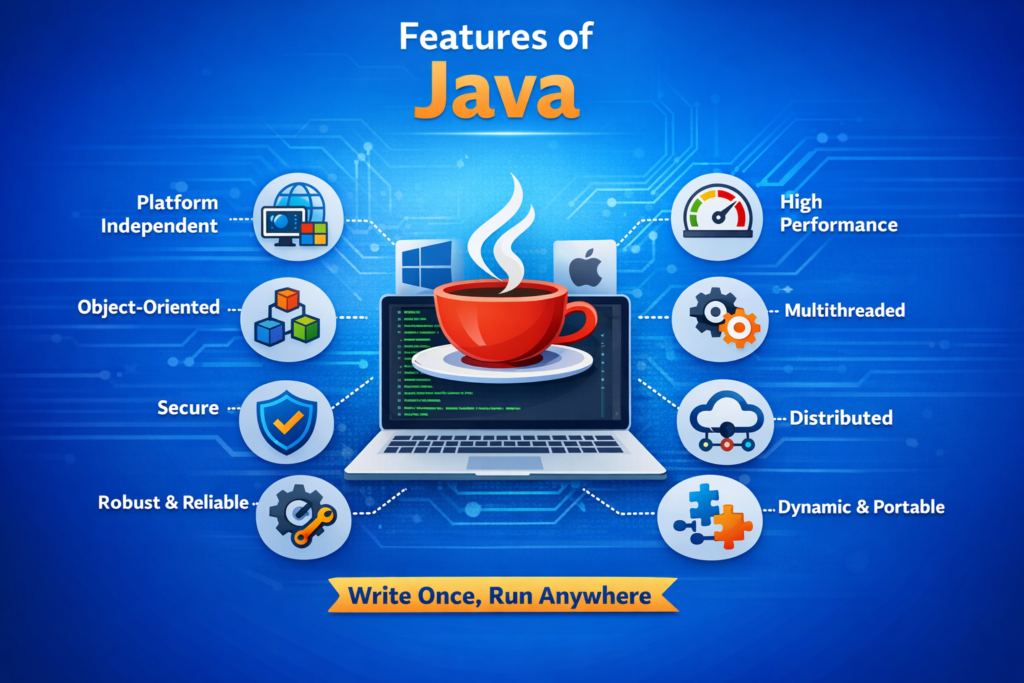
Features of Java
Java is one of the most widely used programming languages in the world. Its popularity comes from a powerful set of features that make Java reliable, secure, and easy to use for building real-world applications. From web and mobile apps to large enterprise systems, Java’s features help developers write clean and efficient code.
Let’s explore the key features of Java in a simple and easy-to-understand way.
1. Platform Independent
One of the biggest features of Java is platform independence.
Java programs are not directly executed by the operating system. Instead, Java code is compiled into bytecode, which runs on the Java Virtual Machine (JVM). Since JVM is available for different operating systems, the same Java program can run on Windows, Linux, or macOS without any changes.
👉 This is why Java follows the principle:
“Write Once, Run Anywhere”
2. Object-Oriented Programming (OOP)
Java is a fully object-oriented programming language.
It uses concepts such as:
Class
Object
Inheritance
Polymorphism
Encapsulation
Abstraction
These concepts help in organizing code properly, improving reusability, and making large applications easier to manage and maintain.
3. Simple and Easy to Learn
Java is designed to be simple and beginner-friendly.
Syntax is easy to read and understand
No complex features like pointers
Clear structure and rules
Because of this, Java is often the first programming language for many students and beginners.
4. Secure
Security is a major strength of Java.
Java provides built-in security features such as:
No direct access to memory using pointers
Bytecode verification before execution
Secure class loading
These features protect systems from viruses, malware, and unauthorized access, making Java a trusted choice for banking and enterprise applications.
5. Robust and Reliable
Java is known for being robust, meaning it can handle errors smoothly.
Strong exception handling
Automatic memory management using Garbage Collection
Compile-time and runtime error checking
These features reduce system crashes and make Java applications stable and reliable.
6. High Performance
Although Java uses bytecode, it still offers high performance.
Java uses a Just-In-Time (JIT) Compiler, which converts bytecode into machine code at runtime. This improves execution speed and overall performance of Java applications.
7. Multithreaded
Java supports multithreading, which allows multiple tasks to run at the same time.
With multithreading:
Applications become faster
Better CPU utilization
Improved user experience
This feature is very useful in games, web servers, and real-time systems.
8. Portable
Java is highly portable.
Once compiled, the bytecode can be moved from one system to another without any modification. As long as the system has JVM installed, the program will run smoothly.
9. Distributed
Java supports distributed computing, meaning applications can work across multiple computers connected through a network.
Java provides libraries that help in:
Network programming
Remote method calls
Building scalable distributed systems
10. Dynamic and Extensible
Java is a dynamic language, which means classes can be loaded at runtime.
New features can be added without restarting applications
Supports dynamic linking
Easy integration with libraries and frameworks
This makes Java flexible and future-ready.
Why Java Features Matter
The powerful features of Java make it suitable for:
Web applications
Android development
Enterprise systems
Cloud and big data platforms
Java continues to evolve while maintaining backward compatibility, which is why it remains relevant even after many years.
Conclusion :
Java’s features such as platform independence, object-oriented design, security, robustness, and performance make it one of the most reliable programming languages in the world. Whether you are a beginner starting your coding journey or a developer building large-scale applications, Java provides the tools and flexibility needed to succeed.
At Easy Hai Code, we focus on explaining Java features in a simple and practical way so that learning becomes easy and enjoyable. Keep practicing, stay consistent, and Java will help you build a strong and successful career in software development.